Showing posts with label reading. Show all posts

Monday, January 17, 2011

Gabrielle Mathiesen and The Open Book Project

British businesswoman Gabrielle Mathiesen is an inspiration. Not only did she not allow her battle with dyslexia keep her down, she used her impairment as a motivating force to achieve an important goal.


Inspirational business women Gabrielle Mathiesen has succeeded despite her struggles with dyslexia, but also says it gave her the drive to work harder to achieve her goals

Open Book Report
Mathiesen has created Open Book, an ambitious project that aims to give dyslexics and those with other reading difficulties a means by which they can manage business transactions. It struck Mathiesen that while the hearing impaired are guided in various buildings and businesses by signs depicting the yellow sign with the symbol of an ear or staff members wearing tags with this sign; the dyslexic community and those with reading difficulties are provided no similar assistance for their literacy issues. As such, she came up with an open book sign to provide assistance to individuals with literacy issues.

Inspirational business women Gabrielle Mathiesen has succeeded despite her struggles with dyslexia, but also says it gave her the drive to work harder to achieve her goals.


A Laughingstock

Mathiesen can still imagine herself the laughingstock of her classmates as the teacher poked fun of her poor literacy skills. Back in the 1950′s and 60′s, dyslexia was a non-issue as far as educators and parents were concerned. Dyslexia sufferers were left to struggle without understanding or sympathy. But today Mathiesen is a successful and independent business woman who says that dyslexia is the reason she arrived where she is today.

Daily Challenges

The young-looking blonde woman says that dyslexia still challenges her on a daily basis, but this reminds her of her aim to get involved and provide help to others with dyslexia. To that end, Mathiesen started an organization for dyslexic children and adults called Literally Challenged. The organization provides the assistance to dyslexics that she and others of her generation never received.

Literally Challenged

Literally Challenged offers help to people with literacy issues and learning disabilities. The latest project of Literally Challenged is Open Book, intended to provide a series of front-line aids to those with literacy issues as they go about their everyday business. The hearing impaired have their by now well-known yellow sign depicting an ear, meant to signal that assistance is provided to the individual with a hearing problem. Now those with literacy skills will have an open book sign to help alert them to trained staff and other forms of assistance available to those with literacy issues.


Open Book's Facebook Logo - click it to see their profile


Pictorial Advice

Mathiesen has come up with the concept of a CD that can help businesses like banks, for instance, to offer a pictorial version of instructions and advice on how to do various transactions, such as applying for a mortgage. Some major UK banks have already put out feelers about how they might work with Literally Challenged to develop such a CD. This can be taken as a sign that businesses understand that dyslexia is a real impairment and pervasive within the general population.

Reduced Workload

Mathiesen says that a well-crafted CD will reduce the workload of business staff while it gives customers with literacy challenges the information they need before committing to a contract. The inspired and inspiring businesswoman says that many dyslexics end up going to loan sharks so they won’t have to deal with complicated bank forms. She believes that a one-stop CD could stop this practice which tends to have tragic repercussions for those who struggle with literacy skills.

Another concept that Mathiesen would like to bring to fruition is the transformation of online written material to voice for the dyslexic computer user.


This article has been copied with kind permission of www.cognibeat.com and can be found here.

Wednesday, January 12, 2011

The Nonuniformity of Dyslexia Symptoms

If you’ve been wondering if your child might have dyslexia, you might have turned to the web to look for a list of dyslexia symptoms. Not long into your search, you begin to feel confused: every website lists a different set of dyslexia symptoms. Why can’t the collective “they” on the worldwide web get their act together? Why does the list of symptoms differ from one site to the next?

The fact is that dyslexia cannot be defined according to a set list of symptoms, since every case is unique. Some cases may be so mild there are almost no discernible symptoms while other cases are so severe that the manifestations of the condition are devastating. In addition to the level of severity of the condition, dyslexia is often accompanied by other learning difficulties such as ADD or ADHD.

Brain Differences

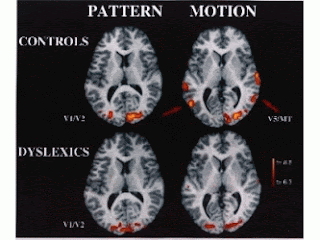
It is also important to consider the fact that dyslexia is caused by a physiological impairment of the brain. There are actual physical differences in the brains of dyslexics which can be seen in imaging studies. These deficits are not “standardized.” Dyslexia, in this light, is almost a catch-all term encompassing many difficulties and levels of difficulties, according to the individual.


MRI scans of dyslexic brain vs. non-dyslexic brain


Functional Brain Mapping

Still, early diagnosis is crucial for a number of reasons. For one thing, it is important to make a child’s educator aware that the child has an actual deficit. This is important even from a psychological standpoint: children with dyslexia should be met with understanding and a helpful attitude by their educators. Without a firm diagnosis, it’s possible an educator might adopt the attitude that your child “just isn’t trying hard enough.” Such an attitude may have an adverse effect on your child’s self-esteem, compounding his problems even further.
Youth Factor

Also, youth is an important factor in ameliorating reading difficulties and other issues relating to literacy skills and math. The earlier we discover the nature of the problem, the sooner we can get the child the help he needs to cope and improve. The brain is capable of making changes throughout the entire lifespan, but certain types of brain changes—specific characteristics of neuroplasticity—are more available at a younger age.

Genetic Predisposition

Despite the impossibility of building a cut and dried list of dyslexia symptoms, a parent may notice some differences in his child that lead him to suspect dyslexia. If you think your child might have dyslexia, have him tested when he turns five. This is even more important for children who have dyslexia or ADD/ADHD in their families, since there may be a genetic factor predisposing a child to these learning difficulties.

This article has been copied with kind permission from www.cognibeat.com and can be found here

Thursday, January 6, 2011

In Full Command

Good Readers are Conscious Strategists

What skills do “good readers” draw upon to make for successful reading sessions? How much of this process is conscious?

Experts have struggled to determine the difference between good and poor readers. One measure experts have used to study these differences it to ask readers to describe their thoughts, out loud, as they read. The result of these efforts is the idea that good reading consists of a number of complex skills that are automatic and well-coordinated in practiced readers.


The coordination of reading skills begins before the start of a reading session. Typical (good) readers set goals for their reading. They note the structure and organization of the text and may make mental outlines to help determine the text’s relevance to their goals. As they read, good readers make fast and accurate work of reading the text while processing the meanings of the words at the same time. They also manage to comprehend groupings of words: phrases, sentences, paragraphs, and so forth.

If good readers fail to understand the text on its surface level, they look to see if they can tie in the context of surrounding sentences to help them make sense of those words. They may dig deep into their own acquired knowledge to help them toward comprehending what is read.


Good readers may interact with the material by asking themselves questions on what they’ve read and may reflect on the ideas contained within the text. They use their background knowledge to predict what will happen next. They engage in constant assessment and revise their predictions as the need arises.
They’re Selective

Good readers are selective. They focus on parts of the text that are related to their reading goals. They may skip over parts of the text because they contain information they already know or because the information isn’t relevant to their goals. They may decide they don’t understand the content of what they’re reading or may find that content boring and decide to pass on reading that chapter or even skip an entire book.

If there are gaps in the writer’s descriptions of characters or events, good readers use textual cues to fill them in, or draw on their own background knowledge to make sense of the text. They can create mental images of characters, settings, or events described in text and use those images to help them better understand written passages.

Good readers monitor their own comprehension as they read. If they realize they haven’t understood what they’ve read, they’ll apply techniques to repair their lack of understanding. They may rephrase what they’ve read or look up a word in a dictionary. They may highlight a passage of text and stop and reflect on that passage.
Uses Metacognition

Good reading involves something called metacognition. Good readers are aware of their own mental processes; their thoughts about their own trains of thought. They review their own comprehension strategies and choose those most appropriate to the text.

When good readers are done with their reading sessions, they reflect on the text they’ve covered. They may summarize key points or find other reading materials to help flesh out the same topic.

Good readers apply strategy to their reading. They have numerous techniques they can use to glean the meaning of the texts they read. These are conscious strategies that are within the readers’ control. They decide when to apply which strategies. They are at all times, in full command of the process.


This article has been copied with kind permission from www.cognibeat.com and can be found here